
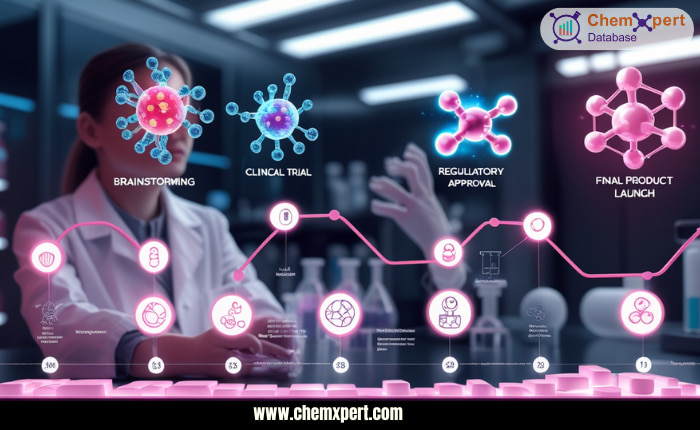
The New Drug Development Process: From Idea to Market (Step-by-Step Guide)

  • Admin
  • Drug Development
  • 1 December 2025

Bringing a new drug to the market is not a straight road. It is long, expensive, highly regulated, and full of checkpoints. Every stage exists for one reason, to make sure the drug is safe, effective, and manufactured with quality.

The journey typically follows a clear path:

Discovery → Preclinical → IND → Clinical Trials → NDA → Post-Marketing Monitoring

Globally, the drug pipeline keeps growing. More than 21,000 molecules were in development last year. India is also rising fast, with 5,500+ pharma companies now investing in R&D.

What Is New Drug Development? A Quick Explainer

A “new drug” can be:

  • A New Chemical Entity (NCE)
  • A biologic
  • A targeted therapy
  • Or any molecule that has never been approved before

A structured development path exists to protect patient safety and ensure reliability.

Key global regulators include:

  • FDA (USA)
  • EMA (Europe)
  • CDSCO (India)
  • PMDA (Japan)
  • MHRA (UK)

All of them follow the three pillars: quality, safety, efficacy.

Step 1 — Drug Discovery & Target Identification

Everything begins with a biological target—like a receptor, enzyme, or protein that plays a role in a disease.

Researchers use:

  • High-throughput screening
  • Computational modelling
  • AI-driven drug design
  • Genetic and molecular pathway analysis

The goal is simple: Find out what needs to be “fixed” inside the body and what molecule could fix it.

Early Hit-to-Lead Optimization

Once a promising “hit” shows activity, scientists refine it.
They work on:

  • Chemical synthesis
  • Structure–activity relationship (SAR)
  • Balancing potency and toxicity

Step 2 — Preclinical Studies (Safety Before Human Trials)

Before humans are involved, the drug is tested in labs and animal models to understand:

  • Toxicity
  • Biological activity
  • Absorption and metabolism
  • Basic safety risks

Key Data Generated in Preclinical Stage

Researchers collect:

  • PK (how the body handles the drug)
  • PD (how the drug affects the body)
  • ADME
  • NOAEL values

All this data shapes the design of human trials.

Preclinical Regulatory Requirements (US, EU, India)

Regulators want strong proof that a drug is safe for human testing.

  • FDA: Follows guidances under the Federal Food, Drug & Cosmetic Act
  • EMA: Requires compliance with European safety standards
  • India: Uses New Drugs & Clinical Trials Rules, 2019

Step 3 — Filing an Investigational New Drug (IND) Application

Before trials begin, companies must show that the drug is safe enough for humans. The IND includes:

  • Preclinical data
  • CMC data (manufacturing, quality controls)
  • Clinical trial plan
  • Investigator details
  • Sponsor responsibilities

How FDA/EMA/CDSCO Review IND Applications?

Regulators check:

  • Safety risks
  • Dose justification
  • Study design
  • Manufacturing quality

Common reasons for IND delays:

  • Missing CMC data
  • Weak toxicity reports
  • Incomplete preclinical findings
  • Problems in trial protocol

Step 4 — Clinical Development (Phase I, II, III)

Phase I — Safety & Dose-Finding

Small group of healthy volunteers.
Goal:

  • Check safety
  • Understand dosage
  • Study early PK

Phase II — Efficacy & Side Effect Patterns

A larger group of patients with the target disease.
Goal:

  • Does the drug actually work?
  • What side effects appear?

Phase III — Large-Scale Confirmation

Hundreds or thousands of patients.
Goal:

  • Confirm efficacy
  • Detect rare side effects
  • Compare with standard treatments

Step 5 — New Drug Application (NDA) Submission & Review

What Regulators Evaluate in an NDA

The NDA is the big one. It includes:

  • Full clinical data
  • Safety and risk assessment
  • CMC data and stability
  • Manufacturing process details

Regulators review the complete benefit–risk profile.

Global Regulatory Timelines

  • USA (FDA) → NDA approval
  • EU (EMA) → Marketing Authorization Application (MAA)
  • India → Form CT-21/CT-22 pathways

Each market has different timelines, requirements, and review structures.

Step 6 — Post-Marketing Surveillance (Phase IV)

Some side effects only appear when:

  • Millions of people use the drug
  • Long-term exposure occurs

That’s why monitoring continues indefinitely.

Global Pharmacovigilance Expectations

  • FDA → FAERS database
  • EMA → EudraVigilance
  • India → PvPI

Companies must continuously report new safety findings.

Regulatory Guidelines That Shape Drug Development

Major frameworks include:

  • FDA’s Federal Food, Drug & Cosmetic Act
  • EMA directives
  • India’s New Drugs & Clinical Trials Rules (2019)
  • ICH guidelines

Why These Regulations Protect Patient Safety?

They ensure:

  • The drug works
  • The drug is safe
  • The drug is made with consistent quality

Every stage exists because real-world harm once happened without these safeguards.

How Chemical Databases Support Drug Development?

Modern drug development is data-heavy. Teams depend on chemical and regulatory intelligence to move faster and reduce risk.

Finding Compounds, Vendors & Regulatory Status

Platforms like Chemxpert help with:

  • API sourcing data
  • Vendor lists
  • DMF status and intelligence
  • Impurity and metabolite information
  • Patent and market insights

Why R&D, CMC, and Regulatory Teams Use These Databases?

Because they speed up everything:

  • Faster identification of viable compounds
  • A clearer picture of regulatory expectations
  • Better supplier qualification
  • Reduced risk of regulatory failure or supply chain gaps

Chemxpert becomes your “data layer” across development.

Conclusion

The path from discovery to approval is long but essential. Each step—discovery, preclinical testing, IND filing, clinical trials, NDA submission, and post-market monitoring—helps ensure patient safety and product quality.

For companies involved in R&D, regulatory affairs, procurement, or CMC, understanding this journey is critical for better decision-making.

If you want to accelerate product development with real-time API, DMF, supplier, and regulatory intelligence:

Explore Chemxpert’s API, DMF & R&D intelligence to power your next drug development project.
Let’s apply Data-Driven Pricing to Your APIs

Sick and tired of always wondering if you are being asked to pay the right price for your APIs? This empowers you with the answers you need to make the right decisions in the Global API market.

Chemxpert Database is one of the biggest and most comprehensive directories of pharma and chemicals, manufacturers, suppliers and information. Provided with current information on prices, demand and transactions, it gives you instant feedback on whether you are buying what is right and at the right time.

Start using market intelligence today and allow yourself to be in control in the API market.

Check it out today and make more informed sourcing decisions! Learn More!

Frequently Asked Questions

The drug development journey includes drug discovery, preclinical studies, IND filing, clinical trials (Phase I–III), NDA submission, and post-marketing surveillance. Each stage ensures the drug meets global standards of safety, efficacy, and quality.

Drug development is long because regulators like the FDA, EMA, and CDSCO require extensive preclinical data, clinical trial outcomes, CMC documentation, and long-term safety monitoring. Every checkpoint protects patients and reduces the risk of unsafe medicines reaching the market.

An IND application typically includes preclinical data, manufacturing and CMC information, investigator details, and the proposed clinical trial protocol. Regulators review these to ensure the drug is safe enough for human testing.

Pharmaceutical market intelligence platforms like Chemxpert help teams access API sourcing data, impurity profiles, DMF status, vendor information, patents, and regulatory insights. This reduces development delays, strengthens CMC planning, and improves supplier qualification.